1
/
of
6
My Store
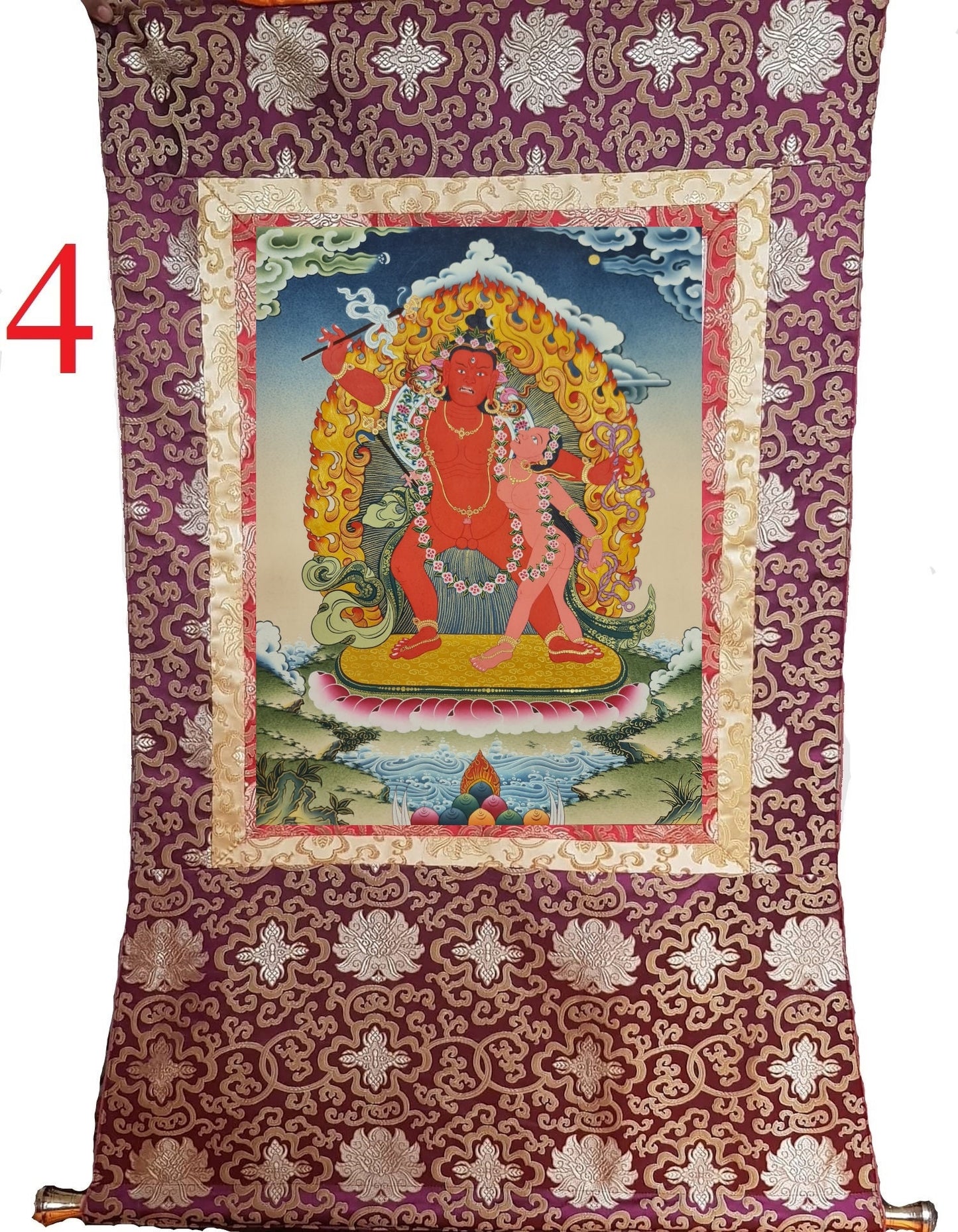
293. Shiva and Parvati Thanka (Thangka). Free Brocade / Free Shipping.
293. Shiva and Parvati Thanka (Thangka). Free Brocade / Free Shipping.
Regular price
$725.00 USD
Regular price
Sale price
$725.00 USD
Quantity
Couldn't load pickup availability
THE STORY OF SHIVA AND PARVATI
Shiva is represented in a variety of forms: in a pacific mood with his consort Parvati and son Skanda, as the cosmic dancer (Nataraja), as a naked ascetic, as a mendicant beggar, as a yogi, as a Dalit (formerly called untouchable) accompanied by a dog (Bhairava), and as the androgynous union of Shiva and his consort in one body, half-male and half-female (Ardhanarishvara). He is both the great ascetic and the master of fertility, and he is the master of both poison and medicine, through his ambivalent power over snakes. As Lord of Cattle (Pashupata), he is the benevolent herdsman—or, at times, the merciless slaughterer of the “beasts” that are the human souls in his care. Although some of the combinations of roles may be explained by Shiva’s identification with earlier mythological figures, they arise primarily from a tendency in Hinduism to see complementary qualities in a single ambiguous figure. Shiva’s female consort is known under various manifestations as Uma, Sati, Parvati, Durga, and Kali; Shiva is also sometimes paired with Shakti, the embodiment of power. The divine couple, together with their sons—Skanda and the elephant-headed Ganesha—are said to dwell on Mount Kailasa in the Himalayas. The six-headed Skanda is said to have been born of Shiva’s seed, which was shed in the mouth of the god of fire, Agni, and transferred first to the river Ganges and then to six of the stars in the constellation of the Pleiades. According to another well-known myth, Ganesha was born when Parvati created him out of the dirt she rubbed off during a bath, and he received his elephant head from Shiva, who was responsible for beheading him. Shiva’s vehicle in the world, his vahana, is the bull Nandi; a sculpture of Nandi sits opposite the main sanctuary of many Shiva temples. In temples and in private shrines, Shiva is also worshipped in the form of the lingam, a cylindrical votary object that is often embedded in a yoni, or spouted dish.
Shiva is usually depicted in painting and sculpture as white (from the ashes of corpses that are smeared on his body) with a blue neck (from holding in his throat the poison that emerged at the churning of the cosmic ocean, which threatened to destroy the world), his hair arranged in a coil of matted locks (jatamakuta) and adorned with the crescent moon and the Ganges (according to legend, he brought the Ganges River to earth from the sky, where she is the Milky Way, by allowing the river to trickle through his hair, thus breaking her fall). Shiva has three eyes, the third eye bestowing inward vision but capable of burning destruction when focused outward. He wears a garland of skulls and a serpent around his neck and carries in his two (sometimes four) hands a deerskin, a trident, a small hand drum, or a club with a skull at the end. That skull identifies Shiva as a Kapalika (“Skull-Bearer”) and refers to a time when he cut off the fifth head of Brahma. The head stuck to his hand until he reached Varanasi (now in Uttar Pradesh, India), a city sacred to Shiva. It then fell away, and a shrine for the cleansing of all sins, known as Kapala-mochana (“The Releasing of the Skull”), was later established in the place where it landed.
Parvati or Gauri is the Hindu goddess of power, energy, nourishment, harmony, love, beauty, devotion, and motherhood. In her complete form, she is a physical representation of Mahadevi, also known as Adi Shakti, the primordial power behind the creation of the universe, the creator and destroyer. She is one of the central deities of the goddess-oriented sect called Shaktism, and the supreme goddess in Shaivism. Along with Lakshmi and Saraswati, she forms the Tridevi.
Parvati is the wife of the Hindu god Shiva. She is the reincarnation of Sati, the first wife of Shiva who immolated herself during a yajna (fire-sacrifice). Parvati is the daughter of the mountain-king Himavan and queen Mena. Parvati is the mother of the Hindu deities Ganesha and Kartikeya. The Puranas also reference her to be the sister of the river goddess Ganga, and the preserver god Vishnu. For Shaivites, she is considered to be the divine energy between a man and a woman, like the energy of Shiva and Shakti.
Parvati is generally portrayed as a gentle, nurturing mother goddess, but is also associated with several fearsome forms to vanquish evil beings such as Durga, Kali, the ten Mahavidyas, and the Navadurgas.
Parvati is an embodiment of Shakti. In Shaivism, she is the recreative energy and power of Shiva, and she is the cause of a bond that connects all beings and a means of their spiritual release. She is also well known as Kamarupa (the embodiment of one's desires) and Kameshvari (the lady of one's desires). In Hindu temples dedicated to her and Shiva, she is symbolically represented as the argha. She is found extensively in ancient Indian literature, and her statues and iconography are present in Hindu temples all over South Asia and Southeast Asia.
Size:
Size of Canvas: 15 inches by 20 inches
Shipping:
We ship within 2 business day.
DHL Shipping: 5 to 8 business days with tracking number.
Insurance against loss.
We do wholesale too.
Our one and only priority in this business is to provide "Hassle free Customer Satisfaction". We have "Quality Products" with "Cheapest Price" in the market.
Please contact us to resolve any issues. Contact us via email before leaving any negative or neutral comments. We promise you that we will resolve any issues.
Please confirm the return address with us before returning the product.
Share